



A Heart-Brain-Immune “Loop” Is Shown to Contribute to Heart Attack Damage and Suggests New Brain & Nervous System Targets for Intervention
A Heart-Brain-Immune “Loop” Is Shown to Contribute to Heart Attack Damage and Suggests New Brain & Nervous System Targets for Intervention
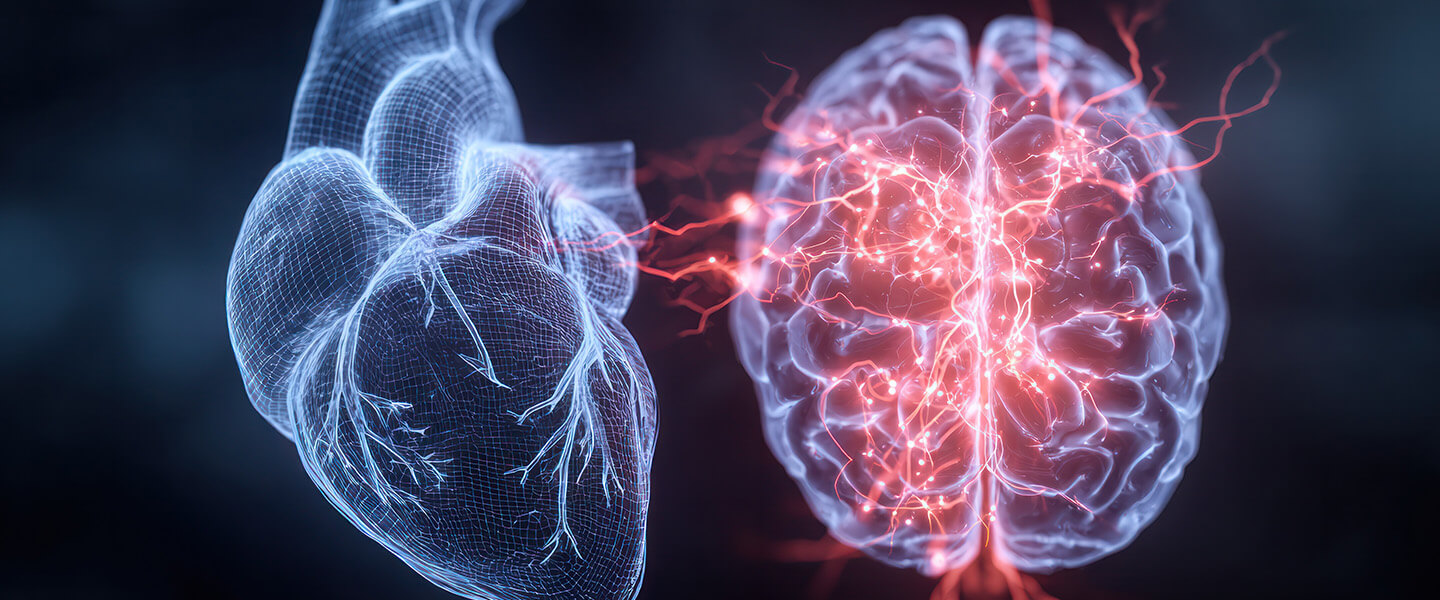

A research team led by a recent BBRF Young Investigator has dissected a bi-directional pathway linking the brain, the nervous system, and the heart whose activation, they have shown experimentally, is intimately involved in damage and destabilization of the heart following a heart attack, but whose manipulation suggests various points of intervention for potential future therapeutics to limit heart damage and accelerate tissue repair post-heart attack.
In a new paper appearing in the journal Cell, Vineet Augustine, Ph.D., a 2023 BBRF Young Investigator at the University of California, San Diego (UCSD), and colleagues including Dr. Kevin R. King, note that while heart attack, or myocardial infarction, is already well known to trigger adverse cardiac events, immune responses, and nervous system activation, the neural and neuro-immune mechanisms involved in the post-heart attack response remain only partly understood and are generally understudied. The paper’s first authors were Drs. Saurabh Yadav and Van K. Ninh, also of UCSD.
Communication between the heart and brain, called cardioception, is facilitated through sensory pathways, including by neurons of the vagus nerve, the longest of the body’s 12 cranial nerves that winds a path from the brainstem down through the neck, chest, and into the abdomen, where it connects to nearly every major internal organ, including the heart.
“The heart-brain axis is responsive to a variety of pathophysiological factors,” notes the team, “including the immune response following cardiac injury” due to a heart attack. The nervous system’s response to heart attack includes enhanced signaling of sensory nerves as well as nerves of the sympathetic nervous system. The latter is part of the body’s autonomic nervous system, which mobilizes rapid, involuntary responses to stress, danger, or even exercise. In complex ways still only partly understood, neural responses to heart attack lead to increased localized inflammation around the heart and throughout the body. Changes are brought about in the architecture of heart tissue, notably in a remodeling of the ventricles, a key factor contributing to heart failure following the initial blockage of blood flow to heart tissue and tissue death caused by the attack itself.
Some progress has been made recently in studying the role of vagus nerve neurons in heart-brain signaling. But there are a number of important subtypes of such neurons, which as a group are called vagal sensory neurons, or VSNs. The starting point for the newly published study was an effort to study particular vagus nerve neuronal subtypes involved in the heart attack response, and their distinct roles in modulating injury and/or influencing immune responses, as well as how they interact with the brain.
Using a sophisticated suite of molecular biology tools in mice, the team was able to identify a unique subtype of VSNs that are nociceptive, i.e., signal to the brain when they receive signals of damage, in this case from the heart. Called TRPV1-expressing neurons, these cells in the vagus nerve act as relays in the “heart-brain-neuroimmune loop” described by the researchers. Experiments demonstrated that these injury-sensing neurons were genetically distinct from other vagal sensory neurons already known to be involved in other aspects of cardiac signaling including maintaining blood pressure. They are located within a bundle of nerve cells near the base of the skull called the nodose-jugular ganglia.
In mice that had experienced the equivalent of a heart attack, the researchers showed that there was a significant increase in the number of TRPV1 neurons in this brainstem location, as well as evidence of a proliferation of nerve fibers from the same neuronal subtype leading to the border zone surrounding heart tissue rendered dead by the heart attack. Expansion of the border zone is one way in which damage due to heart attack can intensify.
Taken together, the evidence suggests that these sensory neurons in the vagus nerve are involved both in signaling the attack, “upward” to the brain, as well as in spurring activity in the heart itself that is part of the process called ventricular remodeling. Although it may sound constructive or protective, it is in fact the reverse: significant injury to the ventricular wall spurs nerve and other cell proliferation that actually destabilizes the heart and contributes to additional damage that can cause fatal arrythmia or other life-threatening post-attack damage.
In dramatic related experiments, when the team “ablated” or blocked the function of the TRPV1 neurons, heart attack pathology was impressively reduced: the size of the infarct (dead tissue) was reduced, electrocardiograms normalized, heart function improved, and pro-inflammatory immune activity was lower.
The next part of the “loop” described by the researchers involves integration into the brain of “damage” signal sent by the TRPV1-expressing neurons in the vagus nerve. Here, experimental evidence led them to a part of the hypothalamus called the PVN (paraventricular nucleus). Sensory inputs carried by TRPV1 neurons were primary drivers of PVN activity following heart attack. Within the PVN, they found a particular neuronal subtype—neurons expressing a receptor called AT1aR—that were receiving the damage signals. These AT1aR neurons were specifically activated following a heart attack.
Experiments to block the action of AT1aR neurons in the PVN produced beneficial post-heart attack results similar to those seen in the experiments in which TRPV1 neurons were disabled.
A third portion of the “heart-brain-neuroimmune loop” probed by the researchers was the superior cervical ganglia (SCG), located deep in the neck at the level of the second and third cervical vertebrae. It was known that heart attack induces neuroinflammatory changes that drive not only ventricular remodeling, discussed above, but also accelerate the onset of heart failure following an attack. This, said the team, is associated with disruptions in sympathetic nervous signaling.
To understand mechanisms that link neuroinflammation and heart dysfunction, they measured levels of pro-inflammatory cytokines (immune signaling molecules) in nerve bundles (“ganglia”) in the base of the brain. Their attention was drawn to a significant increase in Interleukin-1 beta (IL-1 beta), a potent pro-inflammatory cytokine, specifically within the SCG. Experiments indicated that heart attack damage signals transmitted to the brain stimulate this pro-inflammatory response, in proportion to the damage sensed. Examination of tissue revealed nerve fibers extending from the SCG to the border zone around dead heart tissue. The team thus deduced a role for the SCG in heart attack-driven neuroinflammation.
When the team injected antibodies against IL-1 beta into the SCG in mice that had experienced heart attacks, heart pathology was mitigated, and cardiac function improved—a result consistent with those in which TRPV1- and AT1aR-expressing neurons in the vagus nerve were removed or disabled.
Cautioning that these experiments were a beginning of a novel research path, and that other immune-related factors, for instance, are likely involved in heart attack-induced heart damage, the team said “further detailed studies are needed to probe the role of the immune system in [cardiac] remodeling [post-heart attack].” Also, they said, “the precise mechanisms through which neuronal signaling in the vagus nerve leads to sympathetic [nervous system] activation are not entirely clear, and more detailed studies on sympathetic nerve receptor activation, post-synaptic signaling, and neurotransmitter release would be required to understand these pathways in greater depth.”
That said, they noted that their study “identifies a sensory pathway by which TRPV1-expressing vagus nerve neurons influence myocardial changes after heart attack, opening avenues for future research into neurogenic modulation of heart function.”
